01392 270 218 www.hvpshutters.co.uk info@hvpshutters.co.uk
What Access Is Required to Maintain Roller Shutters and Security Shutters?
One of the questions we are asked all the time is what access is required to service or maintain roller shutters.
We know shutters are not the most attractive items but routine servicing and maintenance is going to be required.
We completely understand that roller shutters and security shutters aren’t the most attractive feature in a building — and we know that architects, designers, and building owners often want to hide them out of sight. That’s perfectly reasonable. But here’s the thing: roller shutters and security shutters are mechanical equipment, and all mechanical equipment needs to be maintained.
If a shutter motor needs to be replaced — and at some point, it will — an engineer needs to physically get to it. If the barrel housing has been built into a ceiling void, enclosed behind a false wall, or boxed in so neatly that there’s no way in, that motor change goes from a straightforward job to a major building works operation. The same applies to springs, wiring, guide rails, and control panels. The shutter can be hidden beautifully — but access to its working components must be planned for, or the cost and disruption of routine maintenance increases dramatically.
Ultimately, it’s your decision — we can only guide you on what’s required. If you choose to conceal the shutter, that’s absolutely fine, as long as you’re aware that it could create a maintenance challenge further down the line. There are no hard rules on aesthetics; there are only practical consequences worth understanding before you commit to a design.
This article sets out what access is required and why, so that it can be designed in from the start rather than retrofitted later.
Routine Maintenance: What an Engineer Needs to Do
Before considering access, it helps to understand what a routine maintenance visit actually involves. At each service, the engineer will need to:
- Check the motor — inspect for wear, overheating, or signs of failure
- Check the safety brake — confirm it engages correctly and holds the curtain safely in position
- Access and check the control panel — inspect wiring connections, test controls, and confirm the isolator is functioning
- Operate the shutter through a full cycle — running the shutter open and closed to check for smooth, consistent movement, unusual noise, or resistance
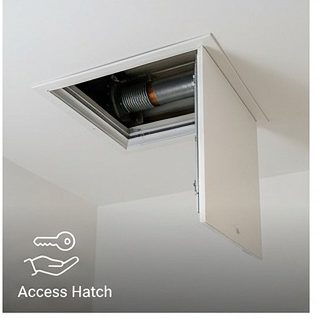
For shutters where components are concealed within the building fabric, inspection hatches are a practical and cost-effective solution they can be designed to be virtually invisible while still giving an engineer the access they need to carry out these checks without disruption to the building.
The Access Points That Matter
Headroom and Barrel Access
The barrel sits in the headroom above the opening and needs to be reachable for inspection, lubrication, and spring or motor replacement. Most commercial shutters require 300–450mm of clear headroom above the opening. Where the barrel is concealed within a ceiling or façade, an access panel large enough for an engineer to reach in — not just look in — is essential.
Note for architects: A well-designed access panel can be completely discreet while still meeting this requirement. The key is planning for it from the outset; retrofitting access later is expensive and disruptive.
Motor and Control Panel Access
The motor — whether tubular (inside the barrel) or external (mounted at the side) — must be reachable for inspection and replacement. External motors need at least 500mm of clear working space in front of the housing.
The control panel and isolator switch must be accessible without moving furniture or removing fixed panels. The isolator needs to be reachable so the engineer can make the shutter electrically safe before working on it. Panels should be at a practical working height — around 1.2–1.5m from floor level — and accessible with the shutter in any position.
Guide Rail and Side Room Clearance
The guide rails on each side of the opening need to be accessible for lubrication, inspection, and replacement. Allow a minimum of 75–100mm of clear side room between the guide rail and any adjacent wall or obstruction. Concealed guides that can’t be reached can’t be maintained — and a damaged guide that goes undetected will eventually cause curtain misalignment and premature wear.
Space in Front of the Shutter
An engineer needs to operate the shutter and carry out checks from in front of it. Keep at least 1.5 metres of clear space in front of the shutter available for servicing. In busy loading bays or high-traffic areas, this should be factored into the surrounding layout.
Emergency Manual Override
Every powered shutter must have a manual override for use when power fails or the motor faults. It must be accessible at all times, clearly identified, and operable by one person without specialist tools. It’s tested at every service visit — if it can’t be reached, it can’t be tested, and it won’t work when it’s needed.
What Happens When Access Hasn’t Been Planned
When maintenance access hasn’t been thought through at design stage, the consequences tend to be practical and costly:
- Incomplete servicing — components that can’t be reached can’t be checked, and faults go undetected until they become failures
- Higher maintenance costs — engineers charge for the additional time required to remove ceilings, panels, or fixtures just to reach the shutter components
- Business disruption — a routine service that should take a couple of hours becomes a half-day or full-day operation, or requires scaffolding or a separate contractor to open up access
- Compliance gaps — roller shutters are work equipment under UK health and safety law (PUWER 1998), and building occupiers have a legal obligation to maintain them; if maintenance can’t be properly completed, that obligation can’t be met
- Shortened shutter lifespan — inadequately maintained shutters wear faster, with springs, curtains, and motors failing well before their expected service life
- Insurance implications — commercial insurers often require evidence of regular maintained service; incomplete records can complicate a claim
Designing for Access: The Questions to Ask
The right time to think about maintenance access is during the design and specification phase — not after the shutter is installed. If you are an architect, facilities manager, or main contractor specifying roller or security shutters, these are the key questions to work through at design stage:
- Is there sufficient headroom above the opening for the barrel and housing, with access for a person to reach in?
- Where will the motor be positioned, and is there working clearance in front of it?
- Are there access hatches or removable panels where shutters are concealed within the building fabric?
- Where is the isolator switch, and is it clearly identified and reachable?
- Is the manual override accessible from the operating side of the shutter?
- Is there sufficient side room clearance on each side of the opening for the guide rails?
Getting these answered before installation means that maintenance is straightforward, safe, and cost-effective for the full life of the shutter — which, if properly maintained, is typically 20 years or more.
We’re Here to Help at Specification Stage
HVP has been manufacturing and installing roller shutters, fire shutters, and security shutters across the UK since 1991. We work with architects, main contractors, and facilities managers at every stage — and we understand that the decisions made at specification stage have a direct impact on how easy and cost-effective a shutter is to maintain over the long term.
If you have questions about access requirements for a current project, or want technical input at specification stage, our team is always happy to help — free of charge, no obligation.
Free site surveys. Expert specification support. No obligation.
Call us on [telephone number] or email [email address] — we’re always available for a conversation.
HVP Security Shutters is ISO 9001:2015 certified, a DHF member, and holds Constructionline Gold accreditation. All engineers are CSCS card holders. We carry £10 million public liability insurance.