TEL: 01392 270 218 info@Roller-Shutters.UK
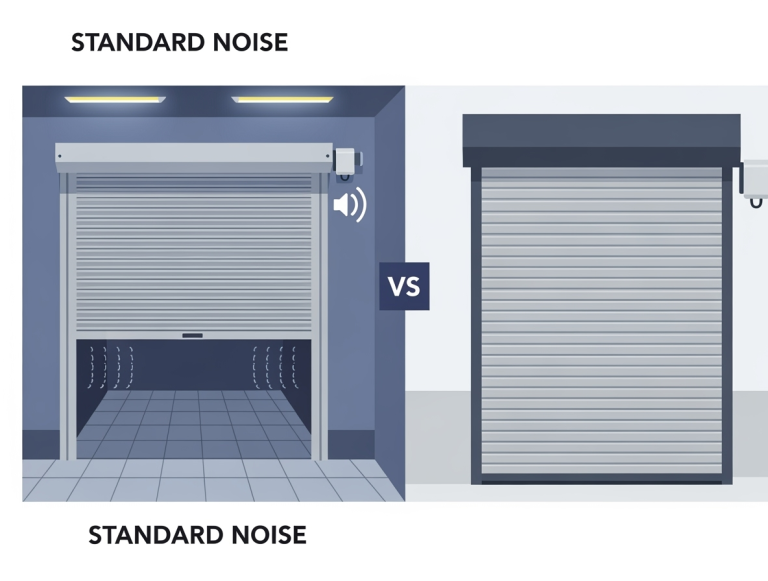
How loud are roller shutters? Low-noise shutter options explained | HVP Security Shutters
If you’re considering roller shutters for a home, shopfront, bar, school, or industrial unit, operational noise is a practical concern—especially for early-morning openings, night-time use near bedrooms, or quiet commercial environments. Here’s a clear guide to what affects shutter noise, what “quiet” really means in practice, and how to specify a low‑noise solution with HVP Security Shutters.
How loud are shutters in operation? Are there low-noise options?
How loud are roller shutters, typically?
General baseline: A well-installed electric roller shutter produces a smooth mechanical hum with brief motor noise during start/stop. For most sites, the sound is comparable to a kitchen extractor or quiet garage-door opener and lasts only for the opening/closing cycle.
Manual shutters: These can be noisier in use due to chain/hand operation and potential rattle from less controlled movement.
Technique matters—firm, even operation reduces clatter.
Site perception: Hard, reverberant spaces (e.g., tiled shopfronts or car parks) can make a shutter sound louder than in carpeted or acoustically soft environments.
What factors influence shutter noise?
Material and build
Aluminium vs steel: Aluminium slats are lighter and typically quieter in motion; steel is heavier and can transmit more mechanical vibration if not well isolated.
Slat design: Insulated/foam‑filled slats dampen vibration better than single-skin profiles.
Guide/channel tolerances: Precise tolerances and quality end locks minimize lateral play and rattle.
Motor and drive system
Motor quality: Modern tube or external motors with soft start/stop reduce jerks that cause clunking.
Duty cycle and sizing: Correctly sized motors run less strained—and quieter.
Speed: High-speed doors can be engineered to be quiet, but poor isolation at higher speeds can amplify noise.
Installation quality
Fixings and substrate: Solid fixings into suitable structure reduce resonance.
Alignment and squareness: Misalignment causes scrape or rumble as slats track.
Isolation: Use of vibration-isolating pads/washers helps cut structure‑borne noise.
Usage and maintenance
Lubrication and wear: Dry guides or worn components increase squeaks and rattle over time.
Debris: Dust or grit in the guides can create scratch noises.
Environment: Wind loading can cause rattling on large external shutters if not specified with appropriate wind locks/guide depth.
Low-noise options and upgrades
HVP can design shutters to operate as quietly as practical for your setting. Common approaches include:
Quieter slat choices
Insulated (foam-filled) aluminium slats for better vibration damping and thermal benefits.
Closed-tolerance slat/end-lock combinations to reduce lateral play.
Low-noise motor packages
Premium tube motors with soft start/stop profiles.
External motors with geared drives and isolation mounts for larger shutters.
Remote controls or group controls to avoid hard switching that can cause jolts.
Guide and seal enhancements
Brush or polymer guide inserts to reduce metal-on-metal contact.
Deeper, reinforced guides with wind locks for large openings to prevent chatter.
Bottom-bar rubber profiles to soften contact at the floor.
Installation and isolation details
Acoustic isolation pads/washers behind fixings on resonant substrates.
Specified fixings and spacing to minimise drumming.
Accurate leveling and squareness checks to maintain smooth tracking.
Maintenance for quiet running
Annual service (every 6 months for fire shutters): inspection, adjustments, lubrication, and safety testing.
On high-usage sites, consider biannual maintenance to keep noise and wear down.
Our service call includes guide cleaning and motor checks to keep operation smooth.
How quiet can shutters be?
While noise output varies by model and site, many of our electric shutters are engineered for low operational sound suitable for residential use and quiet commercial environments. For customers prioritising minimal noise:
Choose electric over manual for smoother motion.
Opt for insulated aluminium slats and soft start/stop motors.
Add guide inserts and isolation details at installation.
Keep to a regular service plan.
Operational noise vs environmental noise reduction
Operating noise: The sound the shutter makes while moving. We minimise this through motors, guides, isolation, and alignment.
Environmental noise reduction: The shutter’s ability to block outside noise when closed. Insulated slats can provide notable reductions in external sound transmission when combined with a tight, well-installed perimeter seal.
When should you specify a low-noise package?
Residential bedrooms or flats above shopfronts
Early/late trading hours near neighbours
Schools, healthcare, hospitality, and offices with quiet-use policies
Multi-bay sites where many shutters cycle frequently
HVP recommendations by application
Residential/Shopfronts seeking quiet operation:
Insulated aluminium slats; premium tube motor with soft start/stop; brush-lined guides; isolation pads at fixings.
Bars/counter shutters:
Chainlink or open-grille products are already low-mass; focus on precise alignment, quality motors, and rubber bottom-bar profiles.
Large commercial/industrial:
Appropriately sized motors, wind locks, reinforced/deeper guides, and isolation between structure and head plates to control resonance.
Lead times, service, and warranty
Lead times: Typical manufacture 4–6 weeks; overall projects usually complete in 6–8 weeks from enquiry to installation.
Servicing: Annually for most shutters; every 6 months for fire-rated shutters. We offer maintenance plans and 24/7 emergency repairs nationwide.
Warranty: 12 months parts and labour on all products for material/shutter failure.
