01392 270 218 www.hvpshutters.co.uk info@hvpshutters.co.uk
The Truth About Roller Shutter U-Values: What the Numbers Actually Mean
When specifying doors for a commercial or industrial building, balancing security with thermal performance can be a challenge. If you are looking at Building Regulations Part L or aiming for a specific BREEAM rating, you will inevitably end up looking at U-values.
The Truth About Roller Shutter U-Values: What the Numbers Actually Mean
When specifying doors for a commercial or industrial building, balancing security with thermal performance can be a challenge. If you are looking at Building Regulations Part L or aiming for a specific BREEAM rating, you will inevitably end up looking at U-values.
However, in the roller shutter industry, thermal performance figures are often misunderstood. Looking at a datasheet and seeing a U-value of 1.1 W/m²K might seem like the perfect solution for an insulated shutter, but it's important to understand exactly what that number represents.
Here is a transparent look at how roller shutter U-values work, so you can make accurate calculations and set realistic expectations for your building.
Understanding the Numbers: The Curtain vs. The Complete Door
The confusion surrounding industrial door U-values usually comes down to how the testing is presented. Across the industry, there are generally two ways thermal performance is discussed:
1. The Lath (Curtain Only) U-Value
Many standard datasheets quote the thermal resistance of the insulated lath in isolation.
- What it is: This figure (often around 1.0 to 1.5 W/m²K) measures the heat loss through a single, solid piece of the foam-filled profile.
- What you need to know: While this proves the material itself is an effective insulator, it is a theoretical figure for the building. It doesn't account for the shutter guides, the bottom rail, the housing, or the joints between the profiles.
2. The Complete Installed Shutter U-Value
This is the thermal transmittance of the entire roller shutter assembly as it sits in the opening.
- What it is: A figure that factors in the whole unit, including the operational tolerances (the physical space required for the metal curtain to slide up and down the guide rails).
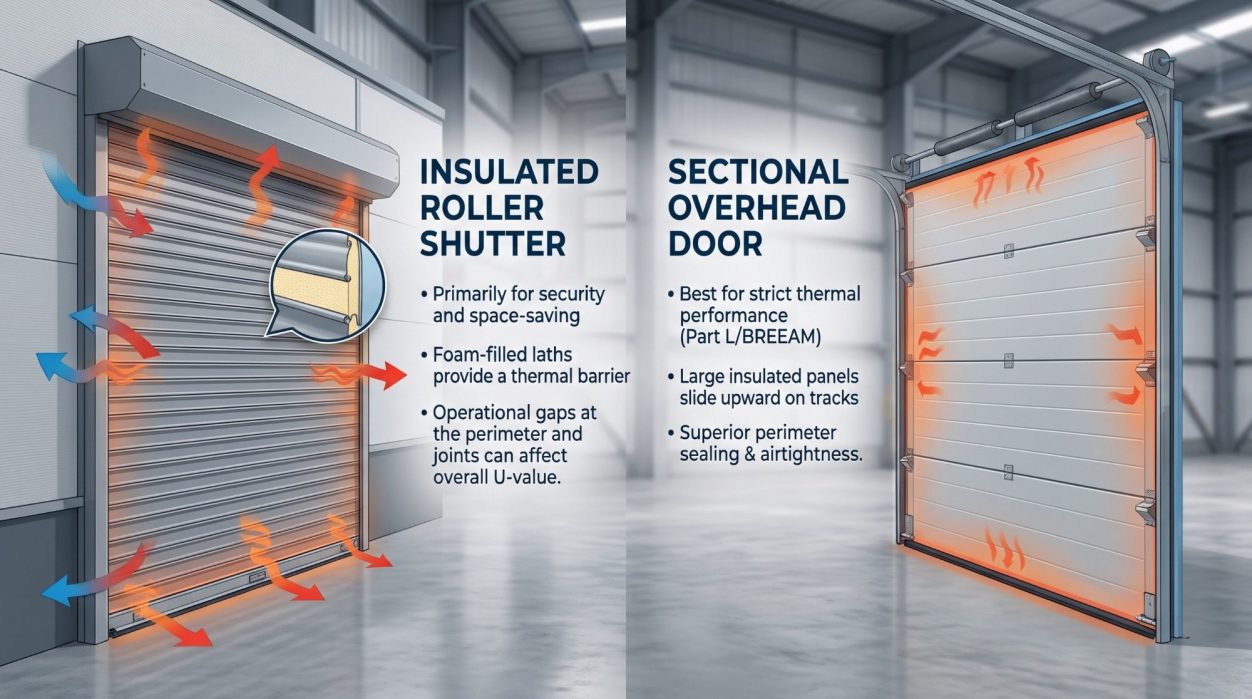
- What you need to know: Because a roller shutter has moving interlocking parts and requires gaps to function, the true, whole-door U-value will naturally be much higher than the curtain-only figure—often closer to 4.0 W/m²K.
The Reality of Roller Shutters and Heat Loss
It is important to be realistic about the mechanical nature of a roller shutter. Even with a high-quality, foam-filled curtain, a roller shutter is primarily a security product.
To physically roll up into a compact box, the curtain needs operational gaps. While brush seals and weather strips help, it is nearly impossible to make a traditional rolling shutter 100% airtight. Therefore, using a "curtain only" U-value in your SBEM or Part L calculations will often result in a gap between the thermal model on paper and the actual heat retention of the physical building.
Choosing the Right Door for the Right Application
At HVP, we believe in being upfront about what our products can and cannot do, ensuring you specify the right door for the right environment:
- Single Skin Roller Shutters: These are designed purely for robust security, access, and airflow. They are not thermally tested and are the best choice for unheated environments, loading bays, or internal security zoning.
- Insulated Roller Shutters: A great middle-ground. The insulated laths significantly reduce noise rattle and offer a good thermal barrier compared to bare steel. They are ideal for units where you want to take the chill off and reduce drafts, while still maintaining a compact roll and heavy-duty security.
- Sectional Overhead Doors: If strict thermal compliance (Part L) or BREEAM ratings are the primary driver for your project, a sectional overhead door is usually the best specification. Because they slide up in solid panels rather than rolling, they allow for much tighter perimeter sealing. Sectional doors are highly effective insulators and are the go-to choice for temperature-controlled warehouses and highly efficient modern builds.
Getting Your Specification Right
Rather than getting caught out by misleading numbers, the best approach is to match the door type to your building's primary needs. If you are currently specifying a project and need straightforward, practical advice on which type of door will meet your security, space, and thermal requirements, our team is happy to help you navigate the options.
- Call Us: 01392 270218
- Email Us: info@hvpshutters.co.uk